What Is Stage 2?
What the four stages mean and how a stock gets tagged with one.
Every stock's price tells a story, and most of those stories follow a similar shape. A stretch where nothing much happens. A stretch where it climbs. A stretch where that climb runs out of steam. A stretch where it falls. WealthLab gives each of these stretches a name — a stage — and tags every stock with the one it's currently in. Stage 2 is the "climbing" part, and it's the one this whole section of the product is built around.
The Four Stages
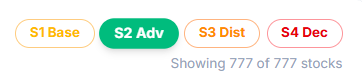
- S1, the base. The stock is going sideways. Nothing dramatic on the chart.
- S2, advancing. The stock is actually moving up. This is usually where most of the gain happens.
- S3, distribution. The move is running out of steam, even if the price hasn't dropped yet.
- S4, declining. The stock is heading down.
Does Every Stock Follow This Order?
Usually — base, then advance, then fade, then decline, then a new base forms. But it's not a rule. Some stocks skip around, or stay in one stage much longer than another. Think of this as the common pattern, not something guaranteed.
How WealthLab Decides the Stage
WealthLab uses a Proprietary method that involves 8 rules to classify every stock into its particular stage.
Common Questions
What are the "stages" and how many are there?
There are 4 stages to a stock as per stage theory: Stage 1 (Basing), Stage 2 (Advancing), Stage 3 (Topping), and Stage 4 (Declining).
Does being in Stage 2 mean the stock will keep going up?
No. It just shows where the stock is right now — not what happens next.
Does a stock always go from Stage 1 to 2 to 3 to 4, in order?
Not always. That's the usual pattern, but it's not something every stock follows exactly.
How long should I hold a stock after it enters Stage 2?
There's no fixed minimum or maximum holding period — it depends on your own investing framework and target returns (some target 10%, others 50%). Refer to the "Build Your Investing Framework" course for guidance on entry/exit rules.
Are stage calculations based on live/intraday prices?
No — stage calculations, RS, leaders, and so on are all done on an End-of-Day (EOD) basis. A live-feed option exists but is currently disabled; this is done to prevent inconsitency and false positives.
Due to intraday volatility, a stock can fall in and out of Stage 2, and yet close flat.
We believe in risk management first. A late confirmation is better than a false one.
Related Articles
What Is a Stage 2 Candidate? · What Is Stage 2 Analysis? · Stage 2 History: The Episode Ledger